
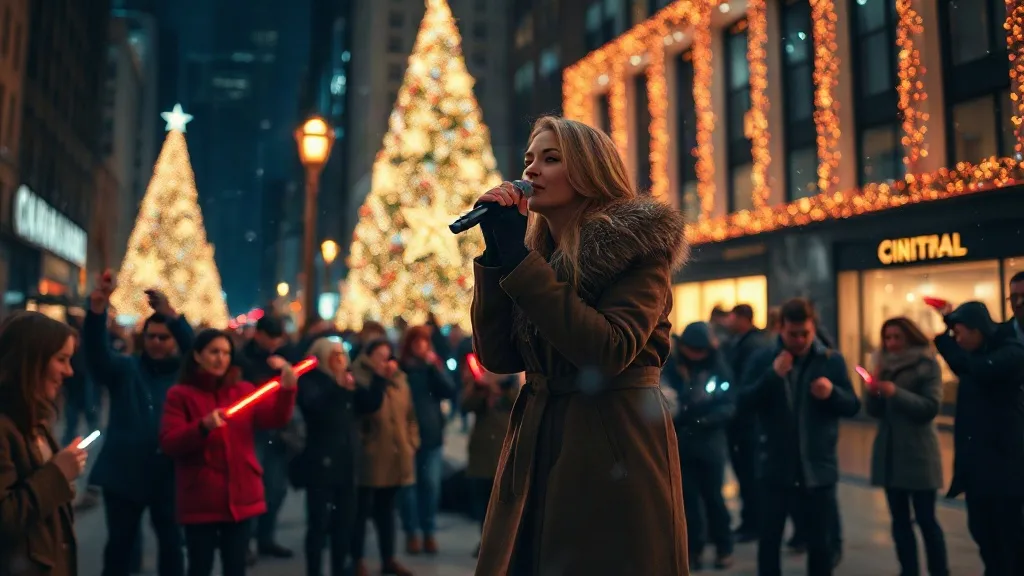
There is a particular kind of pressure that comes with releasing a Christmas song. The canon is crowded, the window is short, and listeners have decades of muscle memory attached to the classics. So when an artist decides not only to release a holiday track but to build an entire seasonal run around it, that is less a marketing decision than a statement of confidence. EJAE is making exactly that bet with Christmas in New York, taking the song from a studio recording into the loudest rooms the season has to offer: the Macy's Thanksgiving Day Parade, a holiday performance tied to Rockefeller Center, and a solo concert of her own on December 14.
On paper it reads like a tidy promotional calendar. In practice, it is a fairly bold way to introduce a holiday single, because each of those stages asks something different of a performer. A parade rewards presence and brevity. A Rockefeller Center holiday set rewards atmosphere and warmth. A solo concert rewards stamina, storytelling and the ability to hold a room for an entire evening. Very few artists get to test all three within a few weeks, and fewer still get to do it with a song that is still finding its audience.
Why the Parade Slot Still Matters
The Macy's Thanksgiving Day Parade is one of the few remaining mass-audience events in American culture. It arrives in living rooms while people are still in pajamas, half-watching between kitchen trips, and it reaches viewers who would never seek out a new holiday single on their own. For an artist, that is the point. A parade performance is not really a concert. It is a three-minute introduction delivered to an audience that did not ask for it, and the artists who make it work are the ones who understand that the camera is the real crowd.
That dynamic suits a song like Christmas in New York, which leans on a sense of place rather than elaborate production. A holiday track about a specific city has a built-in advantage on a broadcast like this one, because the setting does half the storytelling. The floats, the cold air, the crowds along the route: all of it becomes part of the performance whether the artist intends it or not. The risk is that a song can get swallowed by the spectacle. The opportunity is that it can feel like it belongs there.
From Rockefeller Center to a Room of Her Own
The Rockefeller Center holiday programming carries a different weight. It is the image most people associate with Christmas in New York, the tree and the ice and the lights that show up on postcards. Performing in that context puts a song directly inside the visual language it is trying to evoke. For an emerging holiday single, that kind of placement is difficult to buy and easy to squander if the arrangement does not match the setting.
Then comes December 14, when EJAE steps into a solo holiday concert. This is where the season stops being a series of appearances and becomes a test of whether the material can carry an evening. A concert set list built around a single holiday song has to solve a real problem: how do you build ninety minutes around a theme without repeating yourself? The answer usually involves a mix of originals, carefully chosen covers and a few moments of genuine spontaneity. Artists who treat a holiday show as a formal exercise tend to lose the room. Artists who treat it as a party with structure tend to keep it.
The Business Case for a Holiday Single
Strip away the tinsel and a Christmas release is one of the more interesting moves in the music business. Holiday catalogues behave differently from the rest of streaming. They spike hard in a narrow window each year and then go quiet, but the best ones come back annually, compounding attention with almost no ongoing spend. A song that becomes part of someone's December routine is, in effect, an asset that renews itself.
That is why so many artists return to the format even when a holiday single does not chart dramatically in its first year. The value is cumulative. A placement on a parade broadcast, a sync in seasonal programming, a playlist that refreshes every November: these are small deposits that add up over several seasons. For an artist building a career rather than chasing a single moment, a holiday track is less a sprint than a long position.
- Discoverability: seasonal playlists reset every year, giving older holiday tracks a fresh shot at new listeners.
- Live revenue: holiday shows sell tickets in a period when many touring artists go quiet.
- Brand association: a well-placed holiday performance links an artist to a feeling, not just a release date.
- Longevity: a song that sticks becomes annual income rather than a one-off campaign.
What to Watch in This Run
The interesting question is not whether EJAE can perform on a parade float or hold a holiday stage. It is whether the song survives the transition from promotion to habit. That transition happens in living rooms and on car journeys, not on broadcast schedules. If Christmas in New York ends up on a family's annual playlist, the appearances at Macy's and Rockefeller Center will be remembered as the moment it entered the conversation. If it does not, they will be remembered as a well-executed season.
Either way, the strategy is instructive. Rather than dropping a holiday track and hoping the algorithm notices, EJAE is putting the song in front of three distinct audiences in three distinct formats: the mass broadcast viewer, the atmosphere-seeking holiday crowd, and the fan who buys a ticket to spend an evening with an artist. That is a more thoughtful rollout than most holiday releases receive, and it reflects a broader shift in how artists treat seasonal music, not as a novelty but as a genuine part of the catalogue.
For listeners, the takeaway is simpler. The holiday season has a way of surfacing new music in the middle of old traditions, and this year Christmas in New York gets a real chance to become part of that mix. Whether it does will be decided by the same thing that decides every Christmas song: whether people want to hear it again next December.
Frequently Asked Questions
When is EJAE's solo holiday concert?
The solo holiday concert is scheduled for December 14, following her appearances at the Macy's Thanksgiving Day Parade and the Rockefeller Center holiday programming.
What song is EJAE promoting this holiday season?
She is celebrating her track 'Christmas in New York,' which anchors her seasonal performances and the December 14 concert.
Why do artists release Christmas songs if they only chart briefly?
Because holiday catalogues renew every year. A song that becomes part of listeners' December routines can generate streams, placements and live revenue across many seasons rather than in a single window.
What makes a holiday performance different from a regular concert?
Holiday shows carry audience expectations around familiarity and atmosphere, so artists typically balance original material with well-known songs and build the set around a warm, communal tone rather than a standard tour format.
Does a parade appearance actually help a new holiday single?
It can, mainly by reaching viewers who would not otherwise encounter the song. The performance functions as an introduction rather than a concert, and its value depends on whether the song sticks with that broad audience afterward.