
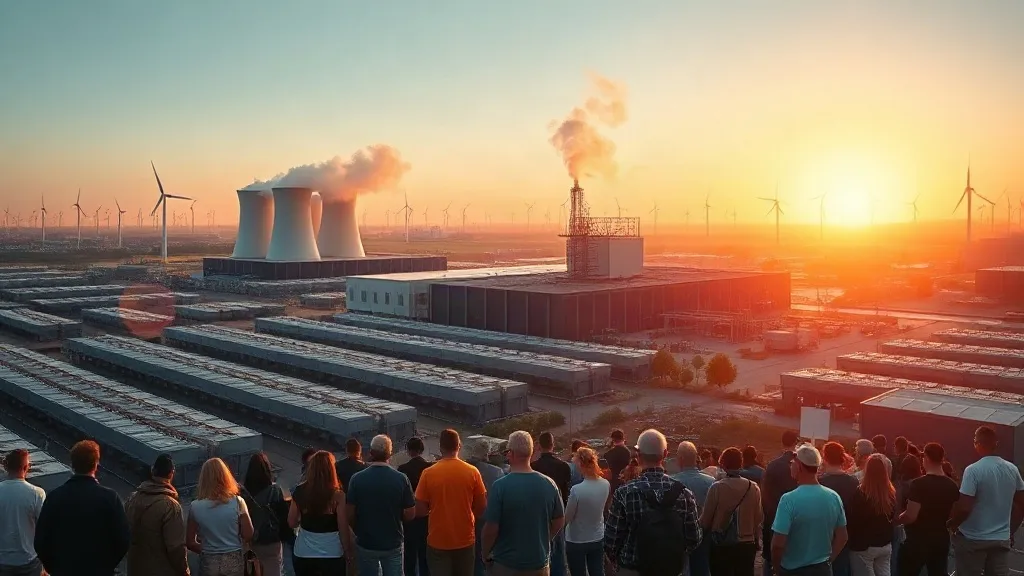
The artificial intelligence boom has largely been framed as a story of limitless computation: bigger models, faster chips, and data centers sprawling across the landscape. But that narrative is hitting a wall. Power grids are straining, water supplies are under pressure, land is scarce, and local communities are pushing back. The question no longer is whether AI will keep growing, but what it will take for that growth to continue within the real-world limits of energy, water, land, and social license.
The Physical Footprint of AI
Behind every AI query lies a vast physical infrastructure. Data centers consume electricity to power servers and to cool them. They require water, often for evaporative cooling, and they occupy land that could be used for other purposes. As AI models grow larger and more complex, these demands escalate. The International Energy Agency estimates that data centers consumed about 1.5% of global electricity in 2022, and that share could double by 2026. In some regions, data centers already account for a significant portion of local power demand, straining grids and raising concerns about reliability.
Water use is equally concerning. A single data center can consume millions of gallons of water per day, competing with local agriculture and residential needs. In water-stressed areas, this competition can become acute. Land use is another constraint: data centers require large tracts of land, often near urban centers where connectivity and talent are available, driving up prices and displacing other uses.
Community Pushback: The Social License to Operate
Beyond physical resources, AI's growth depends on community support. In recent years, local opposition to data centers has intensified. Residents worry about noise, visual blight, and increased utility costs. Some communities have imposed moratoriums or rejected proposals outright. In Loudoun County, Virginia, known as "Data Center Alley," concerns about sprawl and energy use have led to stricter zoning rules. Similar debates are unfolding in Ireland, the Netherlands, and Singapore, where data center growth has collided with housing shortages and climate goals.
This pushback matters because without community buy-in, projects face delays, legal challenges, and reputational damage. Companies that ignore local concerns risk losing their social license to operate, which can be as binding as any permit.
Strategies for Sustainable Growth
To keep AI growing, the industry must adopt smarter approaches. Smarter siting is one key: placing data centers in regions with abundant renewable energy, favorable climates for cooling, and spare grid capacity. Nordic countries, for example, offer hydroelectric power and cool air, reducing both energy and water needs. Facility design innovations, such as liquid cooling and heat reuse, can cut water consumption and improve efficiency. Model choices also matter: smaller, specialized models can often deliver similar results with far less compute, reducing the resource intensity of AI services.
Companies are also exploring on-site generation, power purchase agreements with renewable developers, and energy storage to alleviate grid stress. Some are investing in water recycling and closed-loop cooling systems. These measures not only reduce environmental impact but also enhance resilience against resource constraints.
The Role of Policy and Innovation
Government policies can accelerate or hinder progress. Streamlined permitting for renewable energy and grid infrastructure is essential. So are standards for water use and energy efficiency. Policymakers must balance the need for AI competitiveness with environmental stewardship. Innovation in chip design, such as more efficient architectures and specialized accelerators, can also reduce energy per computation.
Ultimately, the challenge is not to stop AI growth but to make it compatible with planetary boundaries. That requires a shift from brute-force scaling to intelligent optimization, from ignoring externalities to internalizing them.
Frequently Asked Questions
How much energy does AI really consume?
AI's energy consumption varies widely depending on the model and task. Training a large language model can consume hundreds of megawatt-hours, while inference (using the model) adds ongoing costs. Data centers overall account for about 1-2% of global electricity, but AI's share is growing rapidly. Efficiency improvements are critical to keep pace with demand.
Why is water use a concern for data centers?
Many data centers use evaporative cooling, which consumes water. In water-scarce regions, this can strain local supplies. Some companies are switching to air cooling or liquid cooling to reduce water use, but these solutions have their own energy trade-offs.
What can communities do to influence data center development?
Communities can engage in zoning decisions, negotiate community benefits agreements, and demand transparency about resource use. Local opposition has already led to stricter regulations in some areas, prompting companies to adopt better practices.
Are there examples of AI growth being limited by these constraints?
Yes. In Ireland, data centers now account for a significant share of national electricity demand, leading to a de facto moratorium in the Dublin region. In Singapore, the government lifted a moratorium but imposed strict efficiency standards. These cases show that limits are already shaping AI's geography.
How can AI itself help solve these problems?
AI can optimize energy grids, improve cooling efficiency, and accelerate materials discovery for better batteries and semiconductors. However, relying on AI alone is risky; it must be part of a broader strategy that includes policy, investment, and behavioral change.